Stop guessing your next workout.
Calyber tells you what weight, reps, sets, and recovery adjustments to use next, based on the training you actually logged, so more of every block turns into muscle.
THE CORE LOOP
What Calyber does in the gym
Calyber tells you what to lift, how hard to push, and when to adjust, so you can build muscle without guessing.
- Follow the prescriptionCalyber gives the weight, reps, sets, and effort target for the session.
- Log the setBetween sets, log the load, the reps, and how many you had left in the tank (your RIR).
- NEXT SESSIONNext session updatesCalyber reads performance, effort, and recovery, then updates what comes next: push, hold, or pull back.
Calyber updates your next prescription from the load, reps, and RIR you log each set, not from a weekly average.
LOGGED, READ, RECALCULATED
One set in. The engine reads strength and fatigue, then updates the next session.
RIR 2 means two reps left in the tank. e1RM is your estimated one-rep max.
PLAIN LANGUAGE
Training terms, translated
RIREffort target
Reps in reserve. How many more reps you could have done.
Why it mattersTells Calyber whether the set was too light, on target, or too heavy.
e1RMStrength signal
Estimated one-rep max. Your strongest possible single rep, calculated from a set.
Why it mattersTracks whether you are getting stronger, set to set.
HypertrophyTraining goal
Muscle growth.
Why it mattersCalyber is built around growing muscle, not generic activity tracking.
RecoveryFatigue control
Reducing training stress where fatigue is building.
Why it mattersCalyber can adjust the affected area without ending the whole block.
See how your next workout gets decided from the sets you log.
Real app, real engine output. Nothing here is hardcoded.
See the full calculation trail →Select a step to play the recording from that moment.
STATIC TEMPLATE vs CALYBER
Static templates repeat.Calyber recalibrates.
A static template repeats week 1. Calyber recalculates the next week from the sets you logged. Same week 4, two outcomes.
- 3 × 10= three sets of ten reps
- RIR 1= stop with 1 rep left in the tank
- e1RM= estimated max strength, computed from your sets
- Bench Press: +5 lbs and sets 3 → 5
- Shoulder Press: sets 3 → 5
- Lateral Raise: held, fatigue detected
- Bench Press5 sets · 150 lbs × 9 · RIR 1+5 lbs · sets 3 → 5
- Shoulder Press5 sets · 60 lbs × 10 · RIR 1sets 3 → 5
- Lateral Raise3 sets · 20 lbs × 12 · RIR 1held: fatigue signal
The template repeats itself. Calyber recalculated this week from the three weeks of sets you logged before it: more volume where you were progressing, one lift held where fatigue showed.
Not a motivation app.A training calibration system.
Calyber is not built around streaks, badges, social feeds, generic coaching, or motivational copy. It is built to plan, log, adapt, and review hypertrophy training with traceable logic.
Most lifters are not bad at training. They are bad at guessing.
Lifters misjudge how many reps they have left, by about one rep on average, and the error grows the further a set stops from failure.
Halperin et al. (2022). Accuracy in Predicting Repetitions to Task Failure in Resistance Exercise, Sports Medicine 52, 377-390. doi:10.1007/s40279-021-01559-x
Across a block, that error distorts load progression, volume decisions, fatigue timing, and deload calls.
Open each question for how Calyber answers it.
DECISION CHECK 01Should I add weight?
Calyber compares your logged e1RM trend against the prescription and sets the next load from it.
DECISION CHECK 02Should I add or remove sets?
Volume (the number of hard sets you do) tracks against your per-muscle targets and recent performance, not a fixed template.
DECISION CHECK 03Do I need a full deload (a lighter recovery week), or just a local recovery adjustment?
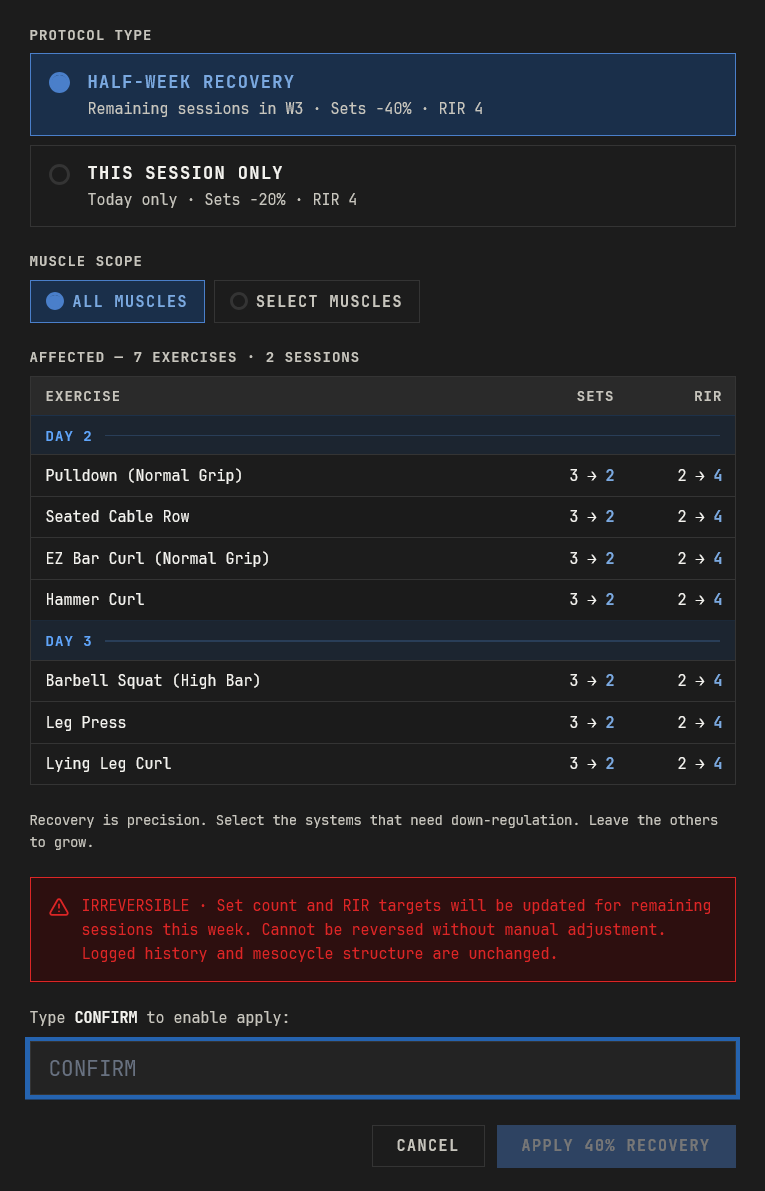
Recovery can be local and temporary. See how Recovery Protocol works.
See how Recovery Protocol works →Know when to push, hold, or pull back.
A fixed program runs the same math no matter what your sessions say. Calyber reads the session and changes the call. Three of the situations that stall most lifters:
A stalled main lift
A fixed plan says
Add 5 lb to the bar every week.
Calyber does
Hold the load and the weekly sets. Let performance recover before adding more.
Training in a deficit
A fixed plan says
Carry the same volume over from your bulk.
Calyber does
Cut sets for the week, back toward the recoverable floor.
A week of missed sets
A fixed plan says
You skipped sets, so you fell behind.
Calyber does
Re-prescribe from what you actually did. No penalty for the gap.
- Build
- Train
- Adapt
- Recover
- Review
One hypertrophy block.Continuously recalibrated.
A block is one multi-week training cycle. Calyber adjusts it every session.
Progression based on RIR, e1RM, and fatigue. Not vibes.
Calyber uses your logged performance, RIR targets, previous sessions, e1RM trends, recovery paths, and fatigue signals to set the next prescription.
- Logged performance
- RIR targets
- Previous sessions
- e1RM trend
- Recovery paths
- Fatigue signals
▸What is part of Founding Member access
Autoregulation, fatigue signals (the readiness and accumulation indices behind the fatigue chip), recovery protocols, and deload commands are part of Founding Member access.
See how Recovery Protocol works →See how one set changes the next workout.
Adjust reps and RIR. The estimate updates from the same e1RM math the app uses.
Recover what needs recovery. Keep building what can still grow.
Calyber helps you reduce stress where fatigue is accumulating without ending the whole block early.
A full deload should not be the only tool between keep pushing and block ruined.
Every exercise gets its own intelligence layer.
Calyber remembers what each lift is becoming.
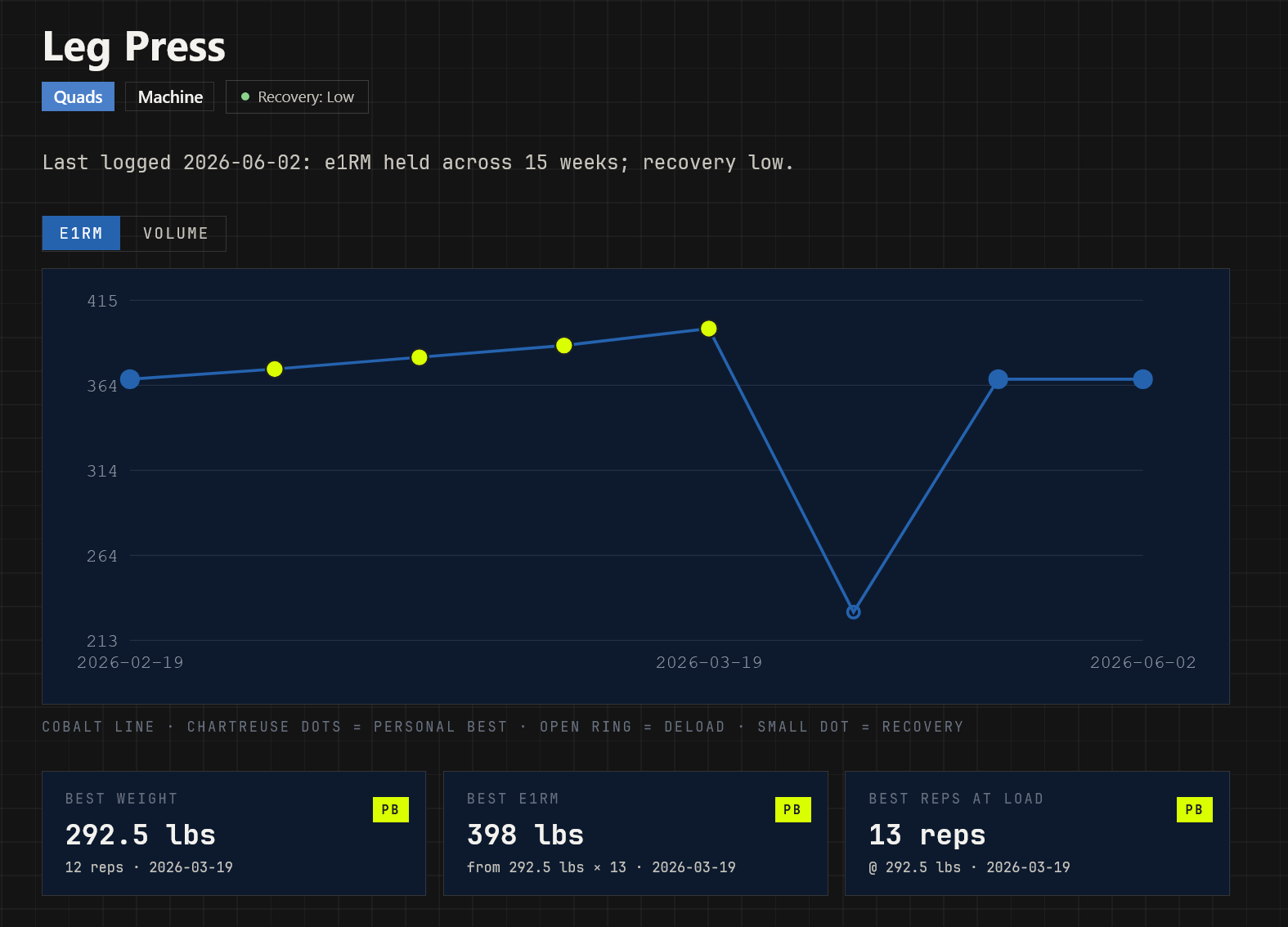
- Baseline W1: 179 lbs
- Peak W6: 193 lbs
- Δ +8%
- 01 / 06Strength trajectorye1RM over time, per lift, with deloads marked.
- 02 / 06PR panelBest weight, best e1RM, best reps at a load.
- 03 / 06Recent sessionsThe latest sessions for this lift, deloads and recovery badged.
- 04 / 06Recovery costWhat this lift costs you to recover from.
- 05 / 06Pinned cuesThe form notes you want in front of you every session.
- 06 / 06Form videoAttach the one you actually trust.
This view deepens as your training history grows.
Built around the muscles you want to grow. Logged in seconds.
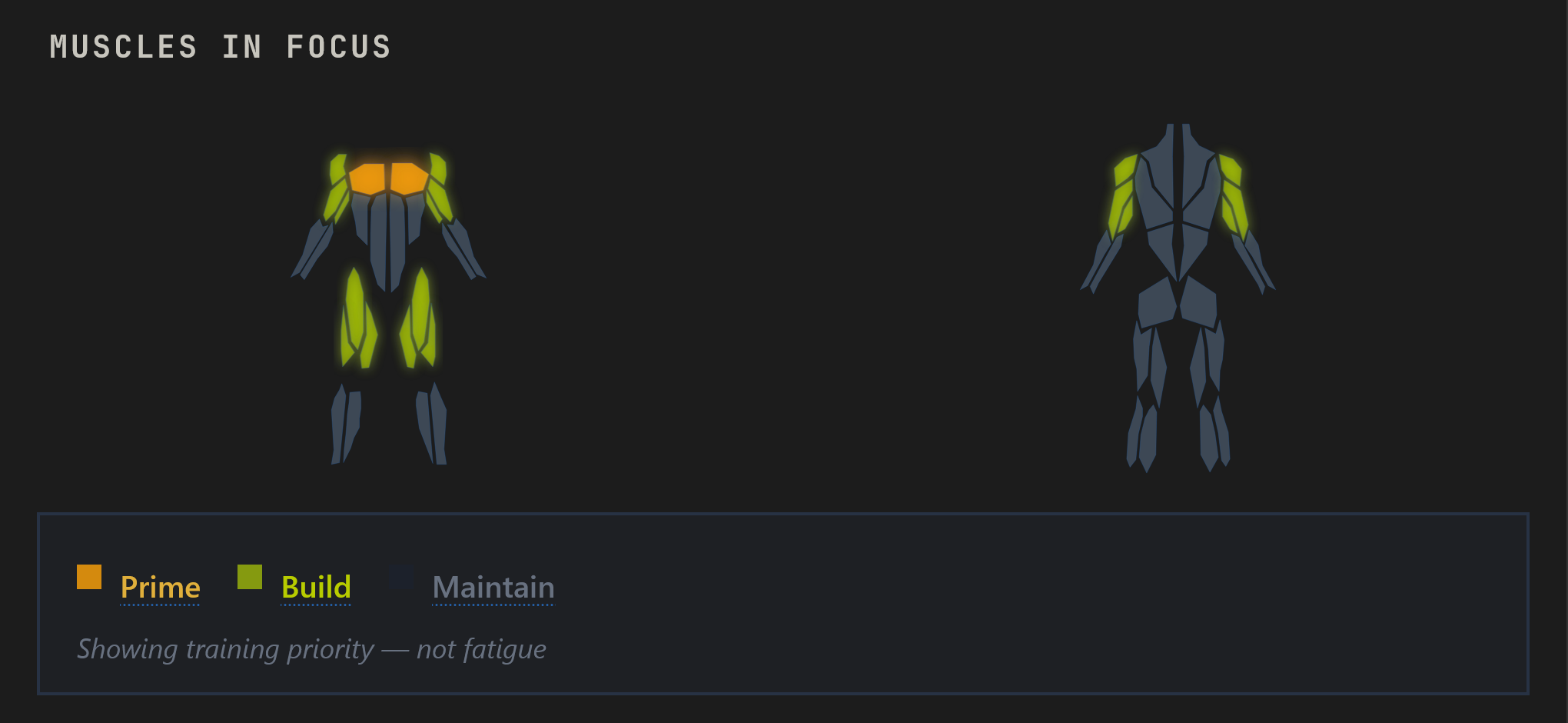
Build around priorities
Calyber shapes your plan around your priorities, not just weeks and exercises.
- PrimeYour #1 focus. The most volume goes here.
- BuildActively growing. A meaningful share of volume.
- MaintainHeld at current size. Just enough volume to keep it.
Log only what matters
Fast enough to use between sets. You log load, reps, and RIR. Calyber computes the rest.
- Load
- 145 lbswhat you lifted
- Reps
- 10what you completed
- RIR
- 2what you had left
YOUR FIRST 28 DAYS
What a free calibration block looks like.
- Day 1Build your first block and log your first session.
- Week 1Prescriptions already adjust from the sets you logged.
- Week 2e1RM and fatigue trends sharpen as history builds.
- Week 3Each exercise shows its own strength trajectory.
- Week 4You have seen the full decision range: progression, local recovery, and deload logic.
No card required. Your history stays visible after the block; logging new workouts then moves to a subscription.
Finish the block with proof.
Review completed workouts, total sets, volume progression, muscle feedback, exercise history, and PRs. Close the block and share a clean training summary.
▸Training terms Calyber uses.
- RIR
- Reps in reserve. How many more reps you could have done.
- e1RM
- Estimated one-rep max from a logged set.
- Block
- A planned training cycle of several weeks (a mesocycle).
- Deload
- A planned lighter week to shed accumulated fatigue.
- Recovery Protocol
- A local, temporary fatigue reduction that keeps the rest of the block productive.
Start with a real 28-Day Calibration Block.
Build a starter block, log real workouts, track e1RM, estimate RIR bias, and see Calyber adapt from your training data.
- No card required
- No shame streaks
- Works offline mid-workout
- Browser-installed web app
Founding Member access locks $19/month for as long as you stay subscribed. Standard launches at $29.
What happens when the 28 days end?
Nothing is charged, because no card was collected. Your account moves to the Free tier: your full training history stays visible, but logging new workouts requires a subscription.
Why 28 days?
The prescription moves after your first logged session. 28 days is how long it takes to see the engine's full decision range: progression week over week, a recovery adjustment when fatigue accumulates, and a deload call if you need one. The trial starts when your first block is built, not when you create the account.
Do you use streaks or reminders that shame you?
No. There are no streaks, badges, or scolding notifications. Missing a session changes your next prescription, not your standing.
Is there an iPhone app?
There is no app store download. Calyber is a web app you install from the browser: it runs full screen, works offline mid-workout, and syncs your sets when the connection returns. Updates ship without waiting on an app store.